Thermal Power Plant — Working Principle, Layout & Efficiency
A thermal power plant (also called a steam power station) converts heat energy from coal combustion into electrical energy. It operates on the Rankine cycle and is the backbone of electricity generation in countries like India, where coal is abundantly available. In this article, we cover the complete layout, working of each stage, efficiency formula, advantages, disadvantages, and environmental impact of thermal power plants.
Working Principle
A thermal power plant works on the Rankine cycle. Coal is burned in a boiler to produce high-pressure steam. This steam expands through a steam turbine, converting thermal energy into mechanical energy. The turbine drives an alternator that generates electrical energy. The exhausted steam is condensed back into water and recycled to the boiler.
This type of power station is suitable where coal and water are available in abundance and a large amount of electric power is to be generated. In India, thermal power plants contribute approximately 55% of total installed capacity.
Schematic Layout & Stages
The complete arrangement of a thermal power plant can be divided into six main stages:
- Coal and Ash Handling Arrangement
- Steam Generating Plant (Boiler, Superheater, Economiser, Air Preheater)
- Steam Turbine
- Alternator
- Feed Water System
- Cooling Arrangement (Condenser, Cooling Tower)
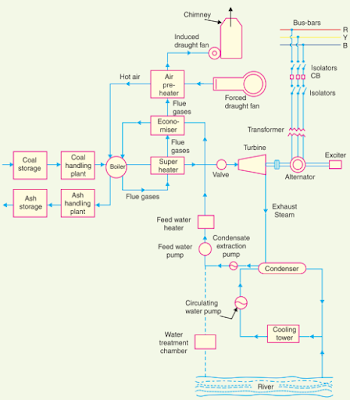
Schematic Arrangement of a Thermal Power Plant
1. Coal and Ash Handling Plant
Coal is transported to the power station by road or rail and stored in the coal storage plant. Storage protects against coal strikes, transportation failures, and general shortages. From storage, coal is delivered to the coal handling plant where it is pulverised (crushed into fine powder) to increase surface exposure, promoting rapid combustion without excess air.
The pulverised coal is fed to the boiler by belt conveyors. After complete combustion, ash is removed to the ash handling plant and delivered to the ash storage plant for disposal. Ash removal from the boiler furnace is essential for proper coal burning.
2. Steam Generating Plant
The steam generating plant consists of a boiler and auxiliary equipment for utilising flue gases:
- Boiler: Converts water into high-temperature, high-pressure steam using heat from coal combustion. Flue gases pass through the superheater, economiser, and air preheater before exhausting through the chimney.
- Superheater: Dries and superheats the wet steam above the boiling point of water. Benefits include increased overall efficiency and prevention of blade corrosion from excessive condensation in the last turbine stages.
- Economiser: A feed water heater that extracts heat from flue gases to preheat the feed water before it enters the boiler, improving cycle efficiency.
- Air Preheater: Increases the temperature of combustion air by extracting heat from flue gases. Benefits include increased thermal efficiency and greater steam capacity per square metre of boiler surface.
3. Steam Turbine
Dry superheated steam from the superheater enters the steam turbine through the main valve. As steam passes over the turbine blades, its heat energy converts into mechanical energy (shaft rotation). The exhausted low-pressure steam then passes to the condenser, where cold water circulation condenses it back into water for reuse.
Modern thermal plants use multi-stage turbines — High Pressure (HP), Intermediate Pressure (IP), and Low Pressure (LP) stages — to extract maximum energy from steam.
4. Alternator
The steam turbine is directly coupled to a three-phase alternator (synchronous generator). The alternator converts the mechanical energy of the turbine into electrical energy. The electrical output is delivered to bus bars through a step-up transformer, circuit breakers, and isolators for transmission at high voltage.
5. Feed Water System
The condensate from the condenser is recycled as feed water to the boiler. Any water lost during the cycle is made up from an external source. Feed water passes through water heaters and the economiser on its way to the boiler, raising the overall plant efficiency.
6. Cooling Arrangement
To improve plant efficiency, exhausted steam is condensed using a condenser. Cooling water is drawn from a natural source (river, canal, or lake) and circulated through the condenser. The heated water is either discharged downstream or cooled in a cooling tower before recirculation. Large plants use natural draft or mechanical draft cooling towers.
Thermal Efficiency
The overall thermal efficiency of a power plant is the ratio of electrical energy output to the heat energy input from fuel:
Typical overall efficiency of a modern thermal power plant is 33–40%. Supercritical plants can achieve up to 45%. The remaining energy is lost as waste heat in flue gases, condenser cooling water, and radiation.
Example: η = 36% → Heat Rate = 3600 / 0.36 = 10,000 kJ/kWh
Comparison: Thermal vs Hydro vs Nuclear Power Plant
Advantages of Thermal Power Plant
- Fuel (coal) is relatively cheap and abundantly available
- Lower initial capital cost compared to hydro and nuclear plants
- Can be installed at any location — coal can be transported by rail or road
- Requires less space compared to hydroelectric power stations
- Generation cost is lower than diesel power stations
- Not dependent on weather or seasonal water availability
- Can handle base load and peak load with proper scheduling
Disadvantages of Thermal Power Plant
- Pollutes the atmosphere — produces CO₂, SOₓ, NOₓ, and particulate matter
- Higher running cost compared to hydroelectric plants due to continuous fuel consumption
- Coal is a non-renewable resource — finite supply
- Large quantity of water required for cooling
- Ash disposal creates land pollution and requires dedicated storage
- Lower overall efficiency (60–67% energy is wasted as heat)
- Longer startup time (several hours from cold start)
Environmental Impact & Modern Solutions
Thermal power plants are the largest source of CO₂ emissions in the power sector. Modern plants employ several technologies to reduce environmental impact:
- Electrostatic Precipitators (ESP): Remove 99%+ of fly ash from flue gases
- Flue Gas Desulphurisation (FGD): Removes SOₓ emissions
- Supercritical & Ultra-Supercritical Technology: Higher steam pressure/temperature for better efficiency (up to 45%)
- Carbon Capture and Storage (CCS): Emerging technology to capture CO₂ before release
Frequently Asked Questions
Q1. What cycle does a thermal power plant work on?
A thermal power plant works on the Rankine cycle, which involves four processes: constant-pressure heat addition in the boiler, isentropic expansion in the turbine, constant-pressure heat rejection in the condenser, and isentropic compression in the feed pump.
Q2. Why is coal pulverised before burning?
Coal is pulverised (crushed into fine powder) to increase its surface area, which promotes rapid and complete combustion without requiring large quantities of excess air. This improves boiler efficiency and reduces unburnt carbon in ash.
Q3. What is the overall efficiency of a thermal power plant?
The overall efficiency of a conventional thermal power plant is typically 33–40%. Supercritical plants achieve up to 45%. The remaining energy is lost as waste heat through flue gases, condenser cooling, and radiation losses.
Q4. Why is a condenser used in a thermal power plant?
A condenser creates a low back-pressure (vacuum) at the turbine exhaust, which increases the pressure drop across the turbine and extracts more work from the steam. It also recovers condensate for reuse as boiler feed water, reducing water consumption.
Q5. What is the difference between thermal and hydroelectric power plants?
Thermal plants burn fossil fuels and have higher running costs but lower initial costs and flexible location. Hydroelectric plants use water's potential energy, have very high initial costs but negligible running costs, zero pollution, and higher efficiency (85–90%). Hydro plants are location-dependent (require hilly terrain with water).